ATT com is one of the largest telecommunications companies in the United States, and most people interact with it in one of two ways: a wireless phone plan or a home internet connection. Both sides of the business have changed quite a bit over the past year, with new pricing structures, simplified fiber tiers, and a bundled plan that ties wireless and home internet together under one bill.
This guide walks through what ATT com actually offers today, how the pricing works, what makes ATT com Fiber different from cable, and how to avoid the common mistakes people make when picking or switching a plan. The goal is to give you a clear picture before you commit to anything, whether that’s a new phone line, a fiber internet account, or a small business setup.

What ATT com Actually Offers
ATT com operates three main consumer-facing businesses: wireless phone service, home internet (fiber and fixed wireless), and business communications. It is one of the largest wireless carriers in the country by subscriber count, alongside Verizon and T-Mobile, and it also owns one of the biggest fiber-to-the-home networks in the US. ATT Fiber plans start around $55 a month for new customers in built-out areas, and that fiber network now reaches a large share of the addresses ATT com serves.
The company’s wireless and wireline divisions used to be sold almost entirely as separate products. That changed in 2026 with the introduction of a combined subscription that folds fiber internet and wireless phone service into a single monthly price, which we’ll cover below.
ATT com Wireless Plans in 2026
ATT com rebuilt its entire wireless lineup in March 2026 under the name Unlimited Your Way. The idea behind it is simple: instead of locking every line on an account into the same plan, each person on a shared account can pick a different tier, and the family still gets the multi-line discount.
There are three current tiers.
ATT com Value 2.0
This is the entry-level unlimited plan. It replaced the older Unlimited Starter plan and actually got cheaper in the process. Pricing runs from about $30 a month per line on a four-line account up to $50 a month for a single line. It includes a small allotment of premium high-speed data, standard-definition video streaming, and a modest hotspot allowance.
ATT com Extra 2.0
The mid-tier plan, replacing the old Unlimited Extra plan, runs roughly $40 to $70 a month depending on how many lines are on the account. Smartphones on this tier get 100GB of high-speed data, and AT&T may temporarily slow data speeds after that threshold if the network is busy. It also comes with a larger hotspot allowance than the Value tier and standard video streaming quality.
ATT com Premium 2.0
The top plan is built for people who stream a lot of video or travel frequently. It includes unlimited high-speed data that does not slow down based on usage, 4K video streaming, ATT com ActiveArmor mobile security, 100GB of hotspot data, and unlimited talk, text, and high-speed data when traveling to 20 Latin American countries. This is the only tier of the three that saw a price increase rather than a decrease when the 2.0 lineup launched.
A Note on Older Plans
If you’ve had ATT com wireless service for a while, you might still be on a retired plan like Unlimited Elite, Unlimited Extra EL, or an older Mobile Share plan. ATT com has been raising prices on these legacy plans, with single-line plans going up by $10 a month and multi-line plans increasing by $20 total, starting in April 2026. If your bill jumped recently and you’re not sure why, this is almost always the reason. Switching to one of the current 2.0 plans is usually the cheaper option at that point, and in many cases it actually includes more data than the old plan did.
ATT com Fiber Internet Explained
ATT com Fiber is wired, fiber-optic internet, which is different from cable internet in one important way: the upload speed matches the download speed. If you’ve ever tried to upload a large video file or host a video call on cable internet and noticed it crawling, that’s the asymmetry cable providers build into their networks. Fiber doesn’t have that problem.
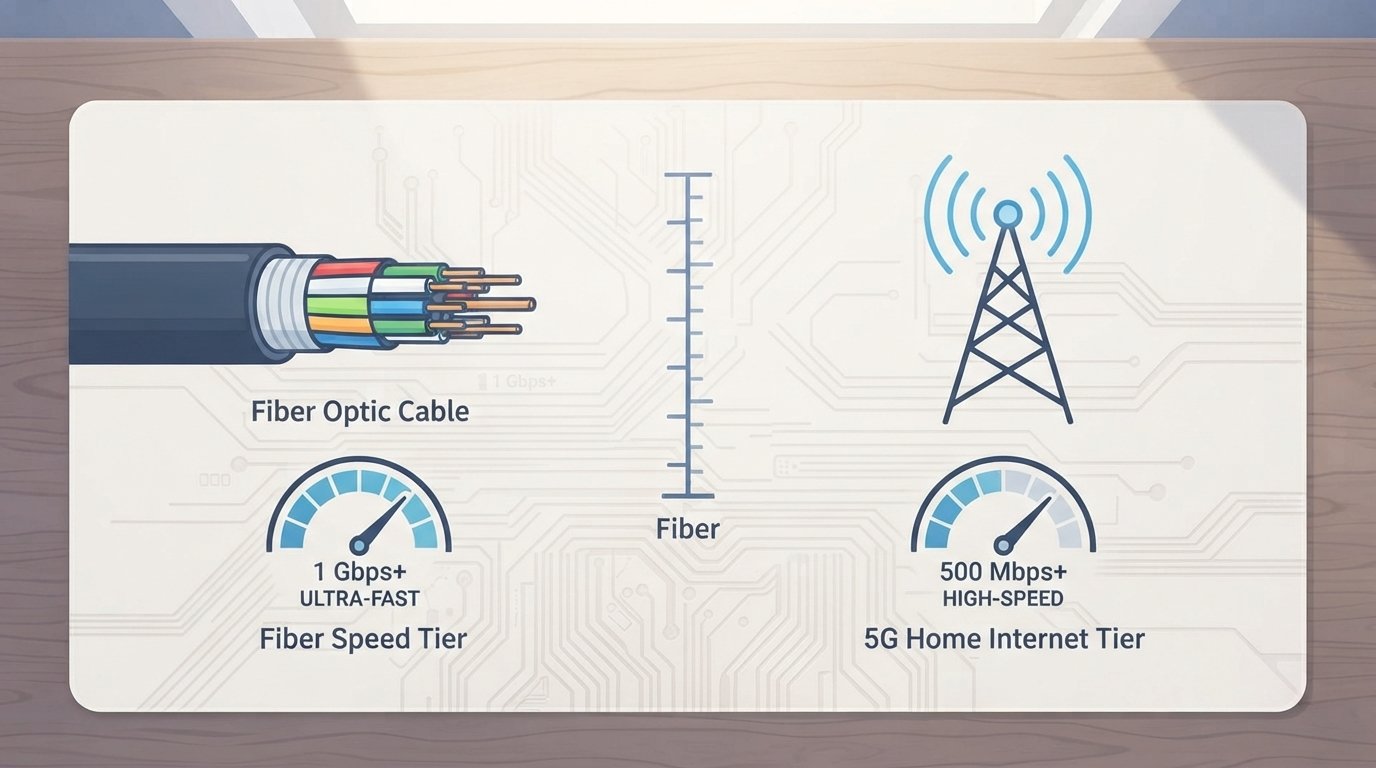
ATT com rebuilt its fiber lineup in June 2026, cutting the menu down to four speed tiers: AT&T Internet 300, AT&T Internet 500, AT&T Internet 1000 (marketed as 1 GIG), and AT&T Internet 5000 (marketed as 5 GIG). Here’s roughly how the pricing breaks down for new customers, based on AT&T’s published rates:
| Plan | Speed (down/up) | Promo price (first 12 months) | Standard price |
|---|---|---|---|
| Internet 300 | 300 / 300 Mbps | around $35/mo | around $60/mo |
| Internet 500 | 500 / 500 Mbps | around $50/mo | around $75/mo |
| Internet 1000 (1 GIG) | 1,000 / 1,000 Mbps | around $50/mo | around $90/mo |
| Internet 5000 (5 GIG) | 5,000 / 5,000 Mbps | around $95/mo | around $135/mo |
Pricing and promotions are address-specific and change over time, so treat this table as a general reference and confirm the current rate for your address directly with AT&T before signing up.
For most households, the 500 Mbps tier is the sensible middle ground. It handles several people streaming in 4K, working from home on video calls, and gaming at the same time without strain. The 300 Mbps tier is fine for one or two people who mostly browse and stream, and the 1 GIG and 5 GIG tiers are aimed at households with a lot of connected devices or anyone doing heavy uploads, like content creators or remote workers moving large files.
ATT com Internet Air
Not every address has fiber built to it yet. For those spots, ATT com sells Internet Air, a fixed-wireless home internet service that runs over the same 5G network as AT&T’s phone plans. It typically runs around $55 a month and delivers speeds in the range of 90 to 300 Mbps down, with a much lower upload speed than fiber, usually somewhere between 8 and 30 Mbps. It’s a reasonable option if fiber isn’t available yet, but it’s not a true substitute for a wired connection if you do a lot of uploading or need rock-solid latency.
ATT com Fiber Availability
Fiber availability depends entirely on whether ATT com has built fiber lines to your specific address, which varies block by block in some cities. The only reliable way to check is to enter your address directly on AT&T’s site, since published coverage maps change as AT&T continues expanding its build-out.
OneConnect: Bundling Wireless and Fiber
In 2026,ATT com launched a bundle called OneConnect that combines a fiber internet plan and wireless phone lines into one flat monthly price, with taxes and fees built in rather than itemized separately. The pitch is straightforward: instead of juggling two separate bills from the same company, you get one subscription and manage both services together. If you’re already planning to use AT&T for both internet and phone service, bundling this way can simplify your monthly expenses and sometimes saves money compared to paying for each service separately, since AT&T also offers a discount for combining wireless and fiber even outside the OneConnect bundle.
ATT com for Business
ATT com also runs a dedicated business division covering internet, wireless, and networking for companies of any size, from a single-location small business to a nationwide enterprise. Business internet plans generally include higher-tier support response times and service level agreements that consumer plans don’t offer, along with static IP address options, which matter for companies running their own servers or remote access setups. Business wireless plans can be customized per employee, with shared data pools or individual lines, and larger organizations typically work with a dedicated ATT business account team rather than general customer support.
If you’re running a small business and deciding between a consumer and a business internet plan, the business option is usually worth the extra cost once you depend on the connection for things like point-of-sale systems, VoIP phones, or multiple employees working simultaneously, since downtime costs more than the plan difference.
ATT comActiveArmor and Network Security
ATT includes a security feature called ActiveArmor on its wireless plans, which screens for spam and fraud calls, flags suspicious links in text messages, and gives users some control over blocking unwanted contacts. It’s included at no extra charge on the Extra 2.0 and Premium 2.0 plans, and a more limited version is available on Value 2.0. It’s worth turning on if you haven’t already, since spam and scam calls remain one of the most common complaints wireless customers have across every carrier, not just ATT.
Checking for an Outage Before You Assume the Worst
If your ATT com internet or wireless service suddenly stops working, the first step is almost never a router reset. Check whether there’s a known outage in your area first, since ATT com publishes outage information for both its wireless and wired networks. A widespread outage usually resolves on its own within a few hours, and restarting your equipment repeatedly won’t speed that up. If there’s no reported outage and the problem is isolated to your home, then it’s worth working through the usual troubleshooting steps: power-cycling the modem and router, checking cable connections, and confirming the issue isn’t on a single device rather than the whole network.
Common Mistakes People Make With ATT com Service
Staying on a legacy plan out of habit. As covered above, older unlimited plans have gotten more expensive over time while the current 2.0 plans often cost less and include more data. It’s worth comparing every year or two.
Assuming fiber isn’t available without checking. AT&T’s fiber build-out has expanded quickly, and a lot of people assume they’re stuck with cable or satellite because fiber wasn’t available two or three years ago. Coverage changes block by block, so it’s worth rechecking.
Picking a speed tier based on marketing rather than actual use. A single-person household rarely needs a 5 GIG connection. Picking the plan that matches your actual number of devices and usage pattern, rather than the fastest available tier, usually saves money without any noticeable difference in daily use.
Not asking about bundling. If you’re already paying for AT&T wireless and considering AT&T Fiber (or vice versa), always ask about the bundled discount before signing up for each service separately.
Ignoring the promotional pricing window. AT&T’s fiber plans often show a lower price for the first 12 months before reverting to a standard rate. Mark your calendar or set a reminder so the price change doesn’t catch you off guard.
Frequently Asked Questions
Final Thoughts
ATT com lineup looks a lot simpler today than it did even a year ago. Wireless plans are down to three clear tiers that can be mixed across a shared account, fiber internet is down to four speed options instead of a confusing list of legacy plans, and the new OneConnect bundle gives people a way to combine both services under one bill. The best approach is still the same one that’s always worked: match the plan to how you actually use your phone or internet connection, rather than defaulting to the most expensive tier, and recheck your options every year or so since pricing and availability both keep shifting.
For background on AT&T as a company, including its history and structure, see its Wikipedia entry.
Source Links
- https://www.att.com/support/article/wireless/000118790
- https://www.att.com/support/article/wireless/000118792/
- https://a0.phonescoop.com/articles/article.php?a=23688
- https://cordcuttersnews.com/att-rolls-out-upgraded-unlimited-wireless-plans-for-2026/
- https://lightreading.com/broadband/at-t-streamlines-fiber-plans
- https://broadbandbreakfast.com/at-t-launches-new-fiber-plans/
- https://en.wikipedia.org/wiki/AT%26T